
A reader emailed me last year, a little embarrassed, asking how much money she needed before she could "officially" start investing. She had heard you needed at least $1,000, or maybe $5,000, to even open an account. So she had been waiting. For three years. Sitting on cash, convinced the door was locked until she had enough to knock.
Here is the blunt truth I gave her: the door has been open the whole time, and you can walk through it with $5. That is just how the math and the modern brokerage account actually work in 2026. The "you need a lot of money first" idea is one of the most expensive myths in personal finance, because the cost of believing it is all the growth you miss while you wait.
The real minimum is smaller than you think
Most major brokerages have no account minimum at all. Zero. You can open a taxable brokerage account or an IRA with nothing in it, link your bank, and transfer $20 whenever you want. What changed things was fractional shares: instead of buying one whole share of a fund priced at, say, $480, you buy $25 worth and own a sliver. The per-share price stops being a wall.
So when people ask "how much do I need to start," the honest answer is whatever your brokerage's smallest fractional purchase is, often $1 to $5. The more useful question is not "what is the minimum" but "what can I add consistently." That second number is the one that builds wealth.
Why $50 a month is not as small as it feels
This is the part that changes how people behave. Imagine you invest $50 a month into a broad index fund, roughly the cost of one modest dinner out. Assume a long-run average return near 7% a year after inflation, a common illustrative figure for a diversified portfolio over decades (not a promise, and any single year can be negative).
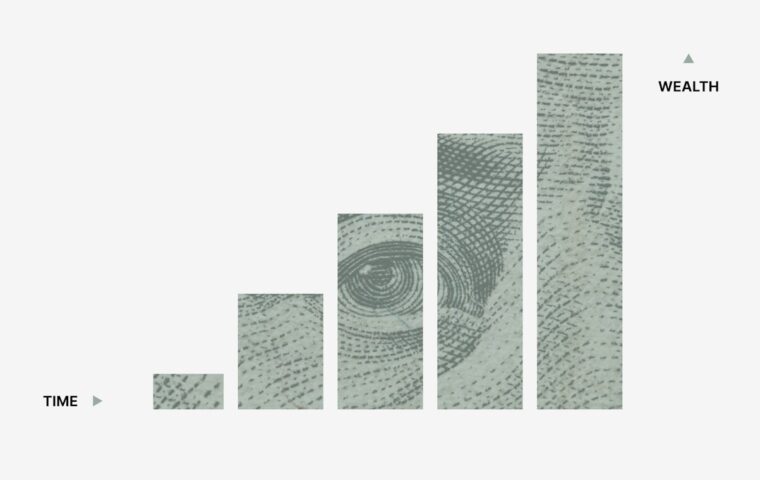
At $50 a month, you contribute $600 a year, so over 30 years that is $18,000 of your own money in. But thanks to compounding, where your returns start earning their own returns, the balance can grow to around $56,000 to $60,000 in illustrative terms. That gap is the whole point of investing instead of saving.
Time does more heavy lifting than the dollar amount. Starting with $50 a month at 25 typically beats starting with $200 a month at 40, even though the older saver puts in far more cash. This breakdown of starting in your 20s versus your 40s shows the real difference compounding makes.
What you should actually buy when you have very little
With a small amount, simplicity wins. You do not need ten holdings or a stock-picking strategy. The most common beginner-friendly building block is a low-cost index fund or ETF that holds the whole US market (or the whole world) in one purchase: thousands of companies, instant diversification.
The number to check before you buy is the expense ratio, the annual fee the fund charges. Broad index funds are cheap, often around 0.03% to 0.10% a year, roughly $3 to $10 a year on a $10,000 balance. An actively managed fund charging 1% skims ten times more, and over decades that difference quietly eats your returns. Cheap and boring usually wins.
If you are still fuzzy on what you are holding, it helps to understand the difference between stocks and bonds in plain English before you settle on a mix. Owning one broad fund is itself one of the simplest ways to diversify your investments, since you spread a tiny amount across the whole market instead of betting it on one company.
Use the free money before anything else
Before you open a brokerage account on your own, check one thing: does your employer offer a 401(k) match? If your job matches, say, 50 cents on the dollar up to 6% of your pay, that is an immediate return you cannot get anywhere else. Capturing the full match is usually the first dollar that should go to investing, even ahead of an IRA.
In plain terms: if you earn $50,000 and contribute 6% ($3,000), a 50% match adds $1,500 of your employer's money. That is a 50% return before the market does anything. Passing it up leaves part of your paycheck on the table.
1) Contribute to your 401(k) up to the full employer match. 2) If you have high-interest debt like a credit card at 20%+ APR, attack that next, since paying off a 20% balance is a guaranteed 20% return. 3) Then open a Roth or traditional IRA and add what you can, even $25 a month. A common framework, not a rule for everyone, but it keeps people from skipping free money.
The account itself: where small dollars live
For most beginners in the US, the two retirement accounts worth knowing are the Roth IRA and the traditional IRA. With a Roth, you contribute money you have already paid tax on, and qualified withdrawals in retirement come out tax-free. With a traditional IRA, you may get a tax deduction now and pay tax later. Both have an annual contribution limit set by the IRS (a few thousand dollars a year, with higher limits at 50 and older), and Roth eligibility phases out at higher incomes. These rules are US-specific, so equivalents differ if you are abroad.
One account people overlook: if you have a high-deductible health plan, an HSA can be invested too, and it carries a rare triple tax advantage.
The mistakes I see beginners make with small amounts
The first mistake is waiting for a "perfect" lump sum that never arrives. Consistency beats size: automating $30 a week beats promising yourself you will invest $5,000 "someday."
The second is chasing whatever is hot, a trendy stock or a coin a coworker swears by, with money they cannot afford to lose. Starting small is the time to build boring habits, not gamble.
The third is panicking when the balance drops. With small contributions, a 15% dip on $400 is $60 on paper, a cheap lesson in how markets behave before the numbers get large. People who keep contributing through downturns are usually buying at lower prices.
Money you might need within the next year or two should not be in the stock market. Keep a starter emergency fund (even $500 to $1,000) in a plain savings account, where it is FDIC-insured up to the standard limit. Investing is for money you can leave alone for years; mixing the two is how people sell at the worst moment.
Enough to make one fractional purchase, often a single dollar. The practical answer: start with an amount you will not miss, automate it, point it at a low-cost diversified fund, and capture any employer match first. The right mix depends on your income, goals, taxes, and state, so for a big decision it is worth talking to a fee-only financial advisor or a tax professional.
Can I really start investing with just $5 or $10?
Yes. Many US brokerages have no account minimum and offer fractional shares, so you can buy a few dollars of a low-cost index fund. The bigger driver of results is contributing regularly, not the size of your first deposit.
Should I pay off debt or start investing first?
It depends on the interest rate. Capturing a full employer 401(k) match usually comes first because it is free money. After that, paying off high-interest debt (like a 20%+ APR credit card) often beats investing, since eliminating that balance is a guaranteed return.
What is the safest way to invest a small amount?
No way to invest is risk-free, but a broad, low-cost index fund spreads your money across thousands of companies, reducing the risk of any single one tanking your balance. Money you may need in the short term should stay in an FDIC-insured savings account.
If you have been waiting for "enough" money to begin, stop waiting. Open the account, automate a small amount, and let time do the work it is uniquely good at. The reader from the top started with $40 a month. A small number, started now, beats a big number started later.